By George Bukenya
Despite the overwhelming number of Science students who applied to take government student loan scheme this academic year, only 2,790 were successful out of the 10,615 applicants.
The Commissioner in charge of Higher Education Student’s Financing Scheme Michael Wanyama revealed that there is increasing demand for the scheme every year but the resource envelope is still small compared to the applications received.
He said that he received 10,625 applications and after screening, 8,005 passed the eligibility criteria but government was only able to take 2790 including the students with disabilities. Out of these 1400 are females represent 50.2 percent and 1390 and males account for 49.8 percent. Of total the successful applicants, only 771 are for diploma programs and 20,019 will pursue under graduate degree programs
“ We are unable to take a sizeable number despite the fact that a huge number pass the eligibility criteria due to the limited funding. For instance, we applied for UGX 13.5 billion planned to at least take 3000 successful applicants but we were allocated 10 billion,’’ commissioner Wanyama revealed.
Since the inception of the scheme, according to Wanyama, government has disbursed a total of UGX 142 billion and UGX billion have been recovered so far from the beneficiaries where only 138 have fully paid.
“ Government has put a mechanism through which the funds will continually be recovered and UGX 100 billion per month is targeted. Parents and Students don’t need to wary because they are given enough grace period through which they will be able to pay, for instance for science beneficiaries its 9 years.
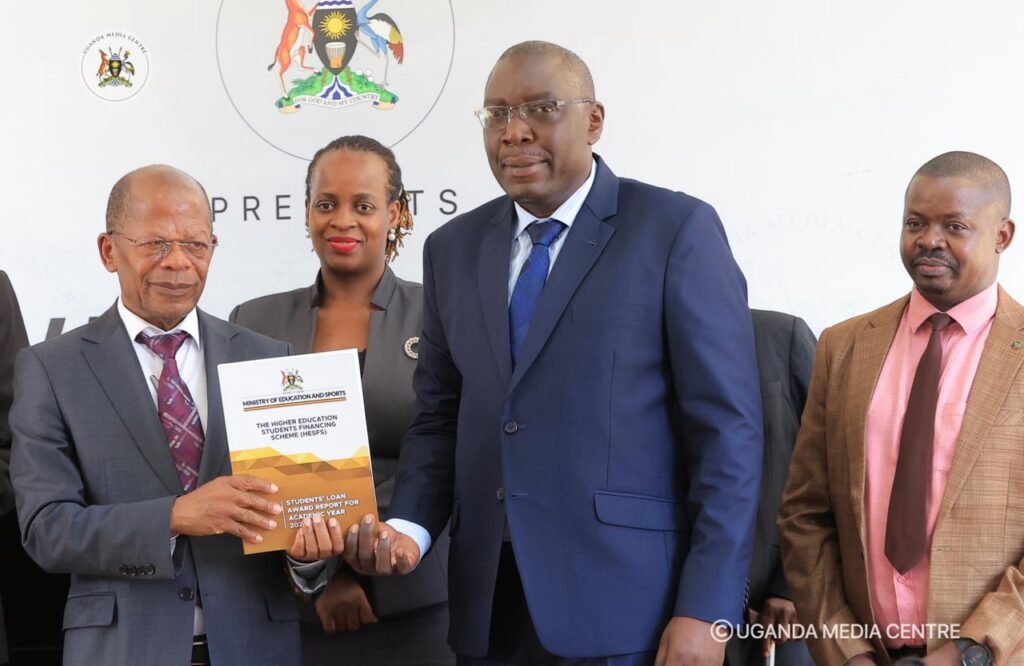
While launching the 13th cohort, the Acting Minister of Education and Sports Dr. John Chrysostom Muyinga said that Bachelor of Science with Education program took the lion’s share of 581 due to the science teachers gap, Engineering was allocated 498 slots again due to the gap occurring in the sector. Whereas Computer Science and Health Care Management and other health services got 313 and 282 loans respectively.
“ The Higher Education Students Financing Scheme (HESFS) is spread through 11 government Universities and 22 chartered Private Universities across the districts basing on the quota system.
“The latest cohort comes at a time when demand for government support for higher education continues to rise, with the Ministry receiving 10,615 applications compared to 7,125 applications in the previous academic year, representing a 48.9 percent increase,’’ Dr Muyingo Explained.

According to the Minister, the selection of the 2,790 successful beneficiaries was undertaken using a three-tier model designed to promote fairness, geographical equity and consideration of financial vulnerability. Under the model, 30 percent of applicants were considered through the District Quota system, another 30 percent were allocated to districts and cities proportionate to their share of eligible applicants, while 40 percent were selected based on their socio-economic vulnerability.
The Minister also said, the approach has ensured representation from all parts of the country, including districts that have historically recorded low participation in the Students’ Loan Scheme such as Amudat, Buvuma, Kalangala, Karenga, Kotido and Moroto.
“The selection process was supported by the Integrated Loan Management Information System (ILMIS), which automatically generated applicants’ Proxy Means Test scores. The assessment considered socio economic background, academic performance, household characteristics, vulnerability factors, disability, parental loss, geographical considerations and other affirmative-action factors.
`The system-based process was designed to minimize human interference and strengthen transparency, accountability and fairness in determining beneficiaries.
The scheme has also increased support for Persons with Disabilities, with 64 students with disabilities among the successful beneficiaries. The beneficiaries will be able to pursue eligible Science and Humanities programs under the provisions applicable to students with disabilities.
Among the programmes attracting the highest number of beneficiaries are Bachelor of Science with Education with 581 students, Engineering programmes with 498, Computer Science with 313, and Health Care Management with 284 beneficiaries.
The loans will cover tuition fees, functional fees and research fees payable to the respective tertiary institutions, as well as aids and appliances for eligible students with disabilities. The funds will be disbursed directly to participating institutions rather than being paid to individual students.
The Higher Education Students’ Financing Scheme was established under the Higher Education Students’ Financing Act, 2014, as amended in 2024, with a mandate to facilitate access to higher education for eligible Ugandan citizens at affordable rates.
The scheme seeks to increase equitable access to higher education, support qualified students who cannot afford higher education, promote regional balance, support programmes considered critical to national development and maintain a sustainable revolving loan fund.
The Ministry has urged successful applicants to follow the communication from the Ministry regarding the next steps. Beneficiaries will receive notifications through SMS, the Ministry website and official social media platforms. They will subsequently be required to sign loan agreements, which will be administered through their respective institutions before funds are disbursed.