By George Bukenya
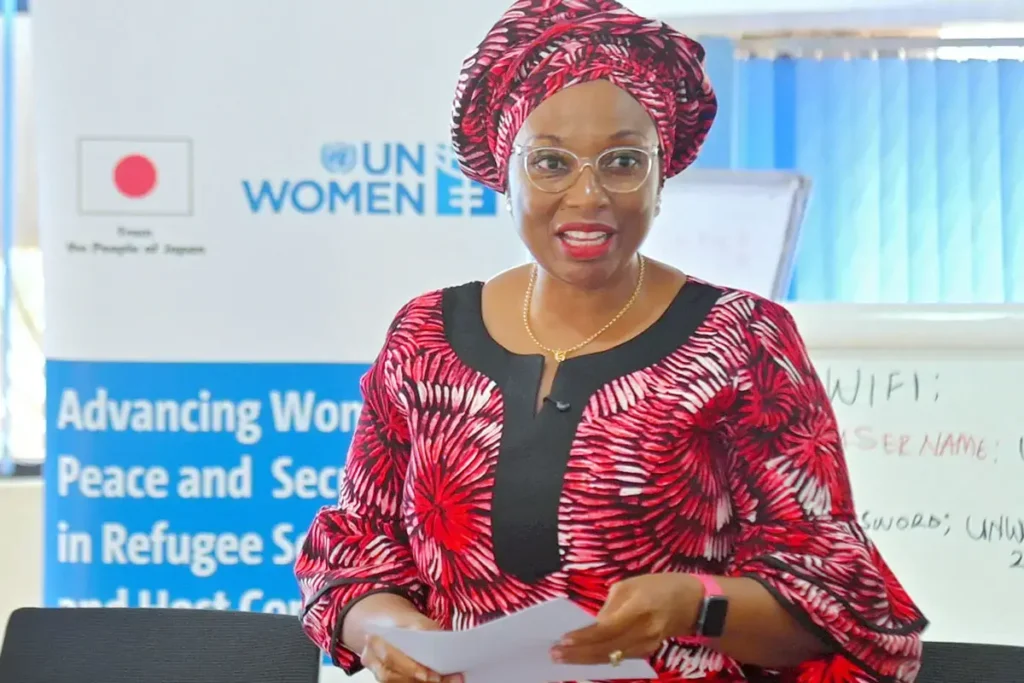
The United Nations Women Country Representative in Uganda, Dr. Pauline Chiwangu has urged women to champion peace and security in the country because their voices can be heard loud.
She asked the government to invest more in women’s leadership at all levels, something she says will help maintain peace and stability in Uganda.
Chiwangu made the remarks while addressing reporters at the Uganda Media Centre in Kampala, as the world prepares to commemorate the International UN Women’s Day, which will take place tomorrow.
“The government should increase financing of local and national action plans relating to women, such as inclusive growth, gender equality advancement, and empowerment of women. This is a key aspect of peace and security,’’ Dr. Chiwangu said.
The Executive Director of Uganda Women’s Network (UWONET) Rita Aciro-Lakor said Uganda, over the years, has registered significant strides in terms of legislation and policy framework necessary to promote women’s rights.
“ We have registered significant strides in legislation of laws needed to protect women and the girl child for instance, the Domestic Violence Act (2010), Anti-Female Genital Mutilation Act (2010), and the three National Action Plans on WPS developed by the government, focusing on enhancing women’s participation in peace processes and aligning WPS goals.
According to Aciro, women’s representation across leadership spheres has also improved, with women now occupying at least 45% of Cabinet positions, 34% of Parliamentary seats, and 49% of the Judiciary.
Aciro, however, said that although some strides have been reached, there are still several challenges hindering women in championing peace and security, and among these are, the very low funding in the National Budget. Gender is allocated only 0.60 % as of 2018, but this has been further reduced to a mere 0-53 for the FY 2024/2025.
“ As women we still face challenges of meagre finding in the National Budget and this hinders our efforts in advocating for women and girl child rights for instance fighting gender based violence,’’ Aciro explained.
It’s from this back ground that she called on government to close the funding gap through increased budget allocation to allow women play a crucial role in agitating for peace and security in the country.
The Director also said that the number of women serving in security forces is still very small for instance in police forces there’s about 7000 police women.
She acknowledged that although there have been several interventions by Civil Society organizations to fight for women rights and curb violence against them, the latter have remained a chronicle aspect in society due to what she termed as ‘poverty of mind’.
The UWONET Director also said that domestic violence has also persisted due to economic poverty, negative cultural norms, some religious beliefs, and weak institutional systems, such as police handling of domestic violence cases.
She said, to eradicate this, there’s a need for increased awareness, social tolerance, handling of negative cultural norms right from the household, education to the masses, and economic empowerment.