By George Bukenya
The Capital City dwellers will soon enjoy cleaner streets, reduced traffic congestion and better new workspaces as Kampala Capital City Authority (KCCA) unveil
A five-year strategic plan aimed at revamping the city by 2030.
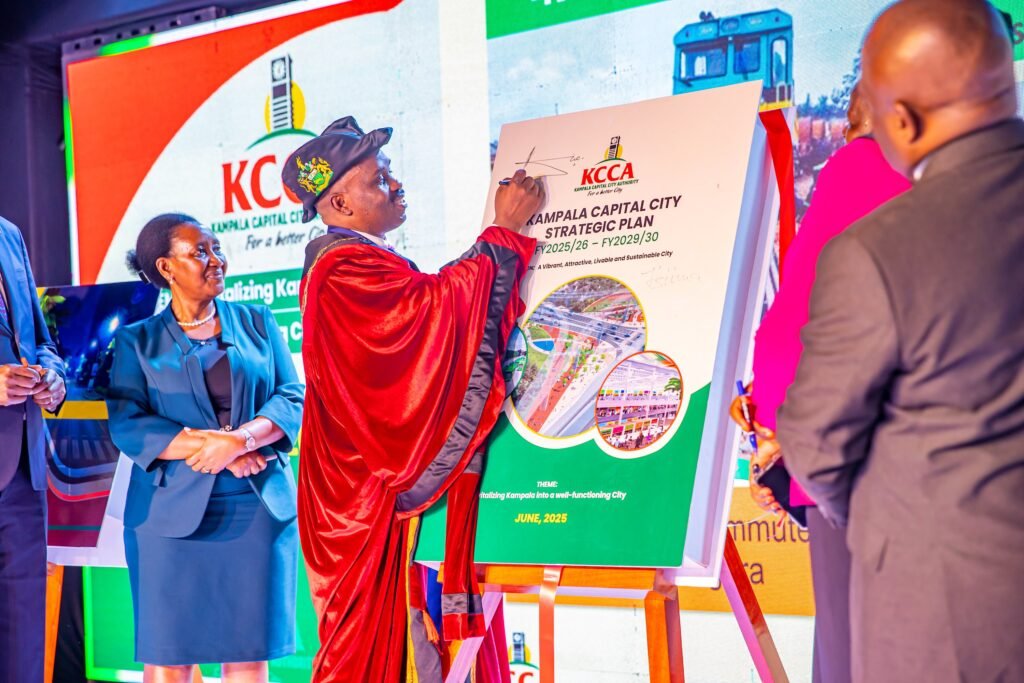
While addressing KCCA’s political leaders, technical and invited opinion leaders at the launch of the blueprint at City Hall gardens, Lord Mayor Erias Lukwago said that the Authority has budgeted to spend a whopping UGX 11.9 trillion to roll out this ambitious plan.
The strategic plan will be implemented under the theme: “Revitalizing Kampala into a Functional City’’, and according to the Lord Mayor , the most pressing challenges such as flooding , traffic-jam and poor waste management will be overcome at the same time boosting social services and economic opportunities.
“I’m extremely deligted to see that these documents are finally here. They give us the framework to manage urban growth and to make Kampala a functional, modern city,” Lukwago said.
The Authority targets by 2030 to upgrade 325 km of roads well paved with walk ways which will see an increase of tarmac city roads from 37% to 52%, this will help save time being wasted while travelling by nearly a third. Bus rapid transit will also be rolled out and commuter rail to Port Bell and Kyengera system will be revamped.
Kiteezi landfill will be replaced with new Buyala waste facility, lifting solid waste collection from 55% to 75% and recycling from less than 1% to 30% , market facilities will also be expanded creating 10,000 new vendor spaces as well as artisan workspaces. Literacy level will also be enhanced to 95% by reducing the pupil-teacher ratio to 30:1, maternal and infant mortality will improve.
Jane Kyarisima the Deputy Head of Public Service said the ultimate test will be felt on the ground when government releases the required funds.
“The actual yardstick of success will not be in the quality of these documents but in the visible transformation in our communities such as clean streets, quality roads, and improved services. These are the real indicators of progress.” Kyarisim asserted
The strategic plan will be funded through taping government transfers, climate finance, public-private partnerships, and introduce municipal bonds.
Officials also expect to grow their own non-tax revenue collections from shs114.3 billion in FY2023/24 to shs165.5 billion by 2030.
KCCA Executive Director Sharifah Buzeki said the plan is a tool for change rather than a paper exercise.
“Together with my team, we believe this goal is achievable. This plan is not a mere policy document, but a change tool that will deliver a capital city of opportunity and progress. We call on all stakeholders to join us in this struggle to ensure we deliver a city that works for everyone.”
Although Lord Mayor Erias Lukwago, who has often criticized KCCA’s policy directions, this time round sounded very optimistic.
But officials admitted success will depend on more than paperwork and financing. They called on residents, political leaders, the private sector, cultural institutions, and development partners to play their part.
“The Plan articulates our vision of a vibrant, attractive, liveable, and sustainable city. With transparency, accountability, innovation, and citizen participation, we will turn this strategy into meaningful results,” Buzeki remarked.
Kampala’s residents could soon see cleaner streets, faster transport, and new workspaces as the Kampala Capital City Authority (KCCA) rolls out an ambitious five-year, shs11.9 trillion strategic plan aimed at transforming the city by 2030.
Deputy Head of Public Service Jane Kyarisima said the ultimate test will be felt on the ground.
Officials also expect to grow their own non-tax revenue collections from shs114.3 billion in FY2023/24 to shs165.5 billion by 2030.
KCCA Executive Director Hajjat Sharifah Buzeki called the plan a tool for change rather than a paper exercise.
“Together with my team, we believe this goal is achievable. This plan is not a mere policy document, but a change tool that will deliver a capital city of opportunity and progress. We call on all stakeholders to join us in this struggle to ensure we deliver a city that works for everyone.”
“The Plan articulates our vision of a vibrant, attractive, liveable, and sustainable city. With transparency, accountability, innovation, and citizen participation, we will turn this strategy into meaningful results,” Buzeki remarked.