
Minister of ICT & National Guidance Kasule Lumumba addressing Journalists at Uganda Media Centre
By George Bukenya
Kampala, Uganda–In an effort to improve communication within government sectors so as to enhance coordination, transparency and public access to accurate information, government has launched the National Communication Policy 2026 which will help guide government agencies to carry out effective and impactful communication.
This also prompted President Museveni to direct the Ministry of Finance, Planning and Economic Development to allocate an additional UGX 200 billion to the Ministry of Information Technology and National Guide to support government communication activities.
The Minister of ICT and National Guidance, Kasule Lumumba, announced the presidential directive during the policy launch at the Uganda Media Centre, saying the proposed funding would support communication efforts both locally and internationally, outside existing budget allocations.
“The policy provides a national framework for coordinated, timely and accurate communication across ministries, departments, agencies and local governments. It seeks to address fragmented government messaging, misinformation and disinformation while strengthening crisis communication, public participation and accountability,’’ Lumumba stated.
Her junior Minister Nabbosa Ssebugwawo said the policy followed years of consultation involving stakeholders from the public and private sectors which helped to make a clear guiding tool
She noted that Uganda’s expanding media and digital landscape offered government greater opportunities to reach citizens with relevant information.
Ssebugwawo also cited figures showing that Uganda has more than 300 licensed radio stations, over 50 licensed free-to-air television stations and 45.7 million active mobile users. The country also has about 17 million mobile internet users, while TikTok and WhatsApp have 11.4 million and 11 million users, respectively.
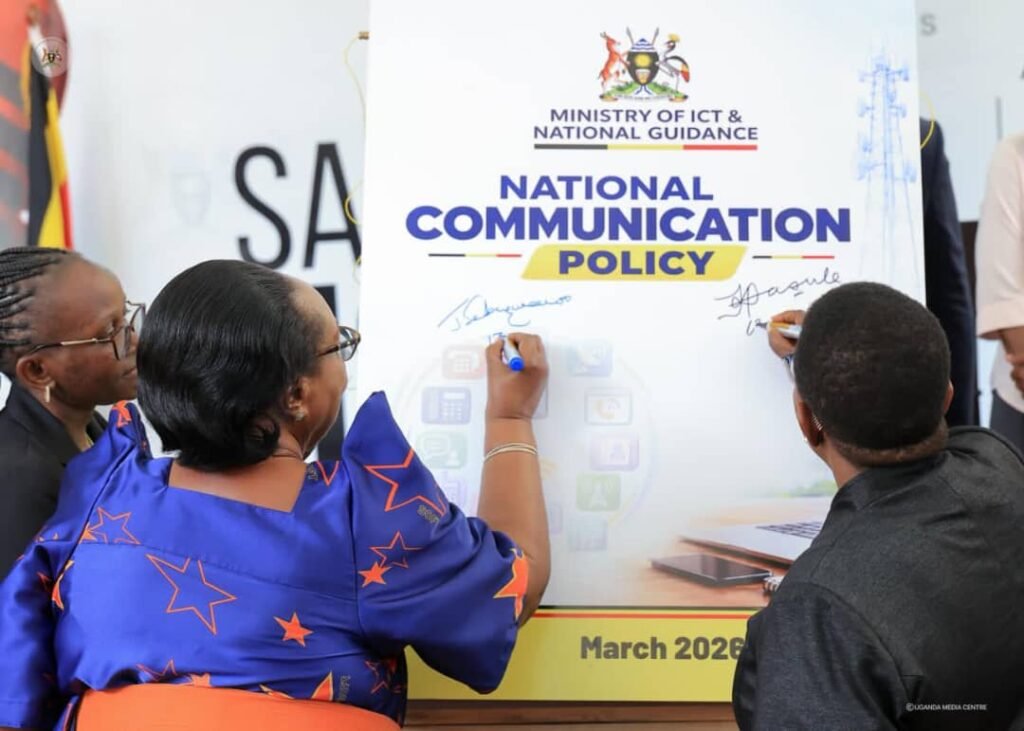
Minister of ICT and National Guidance Kasule Lumumba right and her deputy Nabbosa Ssebugwawo signing on the dummy policy document at the launch
She said the policy would promote consistent government messaging, communication in languages understood by citizens and stronger channels for public feedback.
“Communication is not merely about transmitting information. It is about building understanding, facilitating participation, strengthening accountability, and enabling citizens to engage meaningfully with government,” she said.
The Permanent Secretary in the Ministry of ICT and National Guidance Dr Aminah Zawedde said implementation would focus on translating the policy into practical measures across government institutions.
She said the ministry would provide technical guidance, support institutions in adopting the policy and monitor progress through awareness, implementation and evaluation programmes.
Zawedde urged accounting officers and heads of government institutions to equip communication departments with adequate resources, technology and timely information. She also called for communication officers to be involved in programme planning and regularly updated on government service delivery activities.
“Under the policy, ministries, departments and agencies will be expected to develop communication strategies aligned with the national framework and keep their official websites and other public information channels updated,’’ Zawedde said
The policy will be implemented in collaboration with institutions including the Uganda Communications Commission, Uganda Broadcasting Corporation, Uganda Media Council, Government Citizen Interaction Centre, Uganda Media Centre and the National Information Technology Authority-Uganda, alongside telecommunications service providers and local governments.
Zawedde also said, the success of the policy would be measured by its impact on citizens rather than the number of press releases, meetings or public statements issued.
The assessment will consider whether information reaches its intended audience, is communicated in an understandable language, helps citizens identify the action they need to take and enables them to obtain answers to their questions.
She added that public feedback would help government identify communication gaps and improve the delivery of information and services.
The policy’s launch marks the beginning of its implementation, with the Ministry of ICT and National Guidance expected to guide government institutions, monitor progress and address emerging challenges. The government says the framework is intended to strengthen transparency, accountability and public participation by ensuring citizens have clear and reliable information about government programmes, decisions and available servic