
Minister for Lands Judith Nabakooba stressing a point
By George Bukenya
Kampala, Uganda—-The Minister of Lands, Housing and Urban Development Judith Nabakooba has lifted the ban she had slap on the issuance of special land titles amidst putting stringent guidelines to be followed for those applying for such titles.
Speaking to reporters at Uganda Media Centre on Tuesday, October 20, the minister said that such guidelines will help deter multiple land titles issued on the same piece of land in a fraudulent manner.
Her issuance of such strict guidelines follows long time public outcry on fraudulent land registration a concern also raised by Land registration officials who note that there are overlapping hundreds of existing property titles, warning that the practice threatens land ownership security and undermines public confidence in Uganda’s land registration system.
The guidelines cover applications involving lost or destroyed duplicate certificates, obliterated titles, court-ordered issuance of special certificates and applications made by administrators or executors of estates belonging to deceased persons.
For titles that have been obliterated, applicants will be required to submit an application in triplicate, a supporting statutory declaration, evidence of payment of the prescribed fees, the damaged certificate, a copy of their national identity card and passport-size photographs.
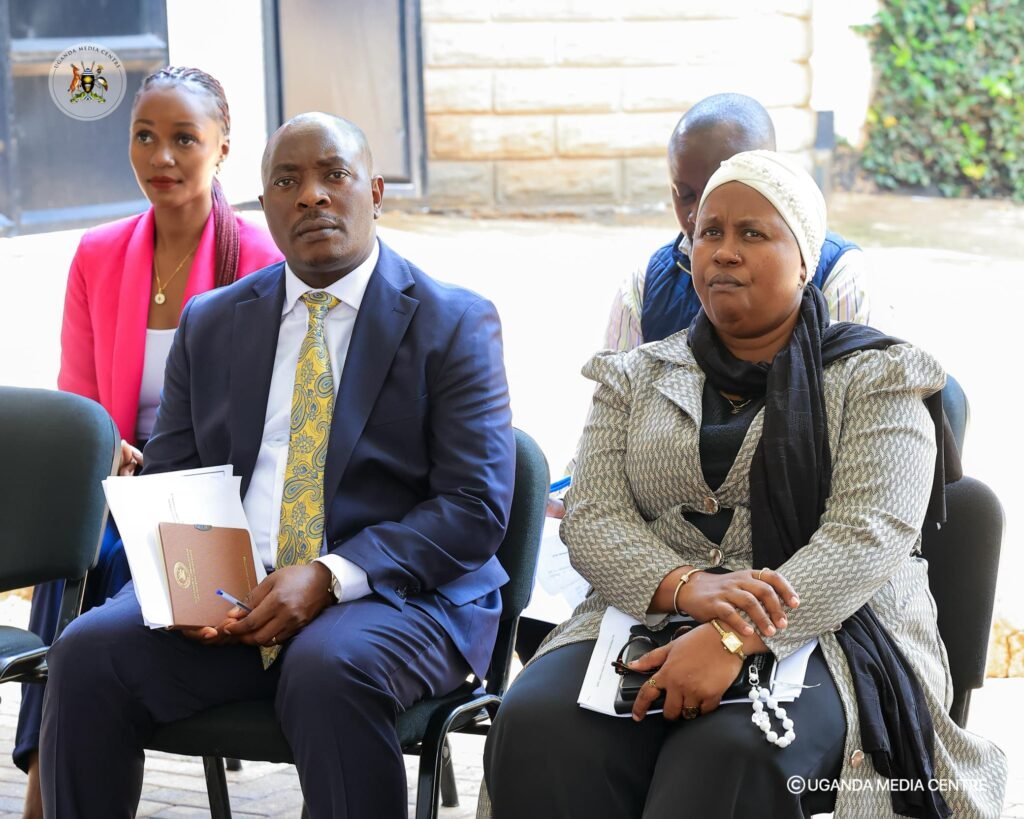
Land Registrars from the Ministry of Lands, Housing and Urban Development
The process will also require an LC1 committee report sign by five of the committee members and an inspection or boundary-opening report.
For lost or destroyed titles, applicants will additionally be required to present a police report confirming that the loss was reported, alongside the relevant LC1 committee report, inspection or boundary-opening report, a Gazette notice, a newspaper advertisement and local notices at the relevant sub-county and LC1 levels.
Applications involving court orders will require a formal letter requesting implementation of the order and a certified copy of the court decision. The registrar will verify the order with the court that issued it and assess the circumstances on the ground, including who occupies the land and the potential impact of issuing the certificate.
Applications made by administrators or executors of the deceased persons’ estates will also require documentation establishing their authority to act, including the relevant probate or letters of administration documents, a copy of the petition for probate or letters of administration, and an inventory of beneficiaries.
The guidelines further require physical inspections to be conducted by government surveyors and the registrar of titles or a land officer, in the presence of the local council committee, which must have a quorum of five members.
Inspection reports must record the proceedings, the people present, the nature of developments on the land, occupancy and the property’s current use.
According to the Minister, officials say some fraudsters exploit legal procedures to obtain new titles over land that has already been registered or dealt with, creating conflicts with previously issued titles and putting legitimate landowners at risk.
They cited several affected properties across the country, including Block 8, Plot 68, at Champeesi, Namayumba; Bugerere Block 54, Plot 7, at Pokotelo, Bali; and Busiro Block 405, Plots 42 and 98, at Wamala.
Other affected properties include Busiro Block 38-3, Plot 15 and 66, reportedly arising from Block 38-8; Busiro Block 260, Plot H, in Kabula Muliro, Ssenge, Nansana; and Busiro Block 42-8, Plots 111, 113, 115 and 117, in Bujiri, Kawuku.
The list also includes Busiro Block 333, Plot 537, in Wakiso, as well as Plots 816, 817 and 506 in the same block.
The officials warned that a single fraudulent title can affect numerous legitimate landowners, particularly where a newly issued title overlaps land that had already been registered under existing titles.
Nabakooba explained that some individuals go through the formal legal procedures required to obtain titles, but allegedly present claims suggesting that the land has never previously been transacted or dealt with. When a new title is subsequently issued, it may overlap several titles that were lawfully registered earlier.
“In most cases, these fraudsters go through all the legal processes to authenticate what they are trying to get. In the process, they go back and claim that the land had never been dealt with,” Nabakooba said.
She also said that official cited an incident in the Wakiso area in which a special process or instrument was reportedly created, resulting in about 200 land titles being affected. Another case in Mbarara involved more than 100 titles and was subsequently cancelled.
In her address, Nabakooba also revealed that cases demonstrate why land registration reforms and stricter guidelines are necessary to prevent the issuance of new titles that conflict with existing ownership records.
“Why am I bringing this to your attention and to the public? It could be one title, but it can cause confusion on a number of other existing titles that were made previously,” she said.
The guidelines are intended to streamline the land register and strengthen the verification of land certificates to ensure that official records accurately reflect the actual status of properties on the ground.
“We are not doing it because of our selfish interest or because I have a special title which I want to make. No. We are doing it to protect the public and the common good,” she stated.
She added that the new stringent guidelines were intended to fulfil Ugandans’ expectations of accountable public service, under the government’s emphasis on fighting corruption and improving performance.
The existing land Act although is still being used on land matters in the country its requires amendment according the minister and she said her ministry is now working on its reform.
The lifting of the suspension means applications for special certificates of title can resume under the new requirements, as the ministry begins consultations aimed at developing a stronger regulatory framework for land registration.