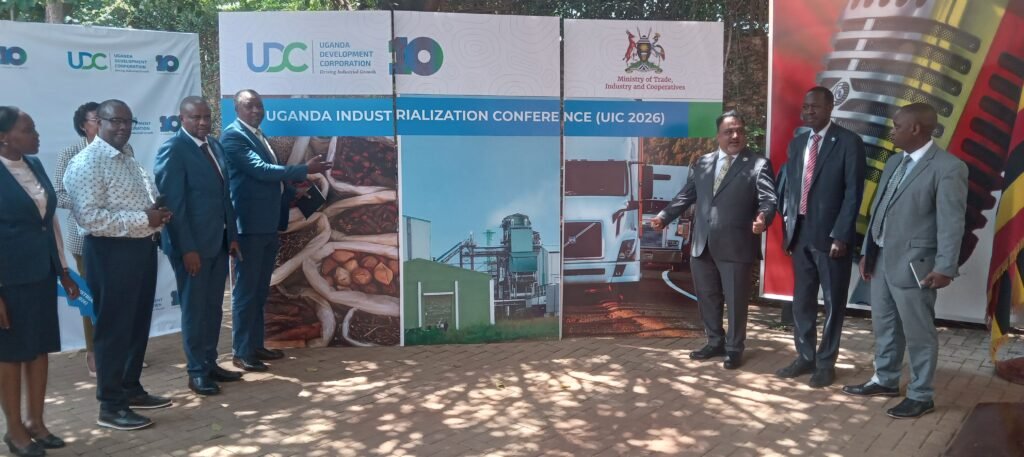
Minister of Trade, Industry and Cooperatives Sanjay Tanna 1st right with UDC officials at UMC
By George Bukenya
Kampala,Uganda-–In a bid to promote her Industrial agenda, Uganda will host the 2026 National Industrialization Conference from November 18 to 20 in Kampala, aimed at bringing together policy makers, manufacturers, investors, development partners and other stakeholders to discuss ways of accelerating industrial growth, promoting local manufacturing and creating jobs.
The two days conference is organized by the Ministry of Trade, Industry and Cooperatives in partnership with the Uganda Development Corporation (UDC) and the United Nations Industrial Development Organization (UNIDO), will be held under the theme “Celebrating Uganda’s Industrial Growth.” It will culminate in the commemoration of Africa Industrialization Day on November 20, alongside celebrations marking 10 years since UDC was re-established in 2016.
Speaking reporters at the launch of the conference activities at Uganda Media Center in Kampala, the Minister of Trade, Industry and Cooperatives, Hon. Sanjay Tanna, said the gathering will provide a platform for government and the private sector to identify practical solutions to challenges affecting manufacturers and translate Uganda’s industrialization ambitions into tangible results.
Tanna also said, government is committed to supporting local manufacturers through improved access to financing, affordable electricity, investment incentives, technology, infrastructure development and expanded access to regional and international markets.
He said Uganda’s industrial sector had recorded significant growth, contributing approximately 25 per cent to the country’s Gross Domestic Product (GDP) in 2025, with an average annual growth rate of 6.4 per cent per annum.
According to the minister, Uganda’s manufacturing sector has expanded from about 81 industries in 1986 to more than 12,000 formal manufacturing enterprises, currently employing approximately 1.8 million people.
He said the government was prioritizing ago-industrialisation, mineral development, tourism and science, technology and innovation under the National Development Plan IV (NDP IV), with manufacturing playing a central role in value addition, export promotion and employment creation.
Tanna added that Uganda had become a net exporter of several products that were previously imported, including soap, sugar, milk, salt, cooking oil, cement, steel, paper and processed food.
The minister said government had committed about $5.8 billion towards the development of regional industrial parks, with the potential to create approximately 163,000 jobs.
On concerns raised by traders regarding taxation, Tanna said the ministry maintained an open-door policy and continued engaging different traders’ associations to address challenges affecting their businesses.
He also echoed the government’s stance on supporting the indigenous investors, saying President Museveni had repeatedly directed ministries to promote local industrialists and businesses.
On the depreciation of the Ugandan shilling, the minister attributed recent exchange-rate pressures partly to external economic factors, including international conflicts, disruptions in trade and reduced foreign-exchange earnings due to closure of boarder with Dr. Congo due to the outbreak of Ebola.
Meanwhile, UDC Executive Director Dr Patrick Birungi said the corporation had invested in 28 companies since its re-establishment in 2016, supporting more than 5,790 direct jobs and several thousand indirect employment opportunities.
He said UDC-supported enterprises purchase more than 35,000 tonnes of agricultural produce annually from farmers and pay approximately Shs138 billion to farmers and local suppliers.
The enterprises also generate about $14 million in export earnings and contribute more than Shs30 billion in taxes to government, according to Birungi.
He said the forthcoming conference would also provide an opportunity to showcase UDC’s investments, partnerships and contribution to Uganda’s industrial development over the past decade.
As part of the activities leading up to the conference, UDC has scheduled several project events, including the groundbreaking of Pamoja Packaging and Industrial Solutions in Mukono, commissioning of a fuel-blending facility in Malaba and additional production lines at South African Medical Vitals in Namanve.
Other planned activities include a ground-breaking ceremony for an animal-feed manufacturing project at Mashada in Bugyala, aimed at strengthening agro-industrial value chains.
Birungi said UDC’s future investment priorities would include animal and fish feeds, local packaging, ethanol-based fuel blending, medical gloves and personal protective equipment, industrial hubs for small and medium enterprises, and financing for viable industrial projects.
Uganda Manufacturers Association representative Dr Ezra Muhumuza welcomed the conference, saying it would provide manufacturers with an opportunity to directly engage government on challenges affecting industrial production.
He said manufacturers expected discussions to address the cost and reliability of electricity, taxation, access to affordable financing, availability of raw materials, labour issues, investment incentives and access to regional and international markets. Muhumuza called on manufacturers from all regions of Uganda, including large, medium, small-scale and cottage industries, to participate in the conference.
He said the association represented more than 24 manufacturing sectors, including steel, poultry, cosmetics, sugar, grain processing, plastics, cement, dairy, textiles, beverages and extractive industries.
On its part, the United Nations Industrial Development Organisation (UNIDO) reaffirmed its commitment to supporting Uganda’s industrial transformation through programmes focusing on industrial competitiveness, innovation, quality infrastructure, skills development, green industry and sustainable manufacturing.
UNIDO representative Bruno Otto said Uganda had made significant progress in industrial development through the growth of manufacturing enterprises, investment in industrial parks and expansion of agro-industrial value chains.
He said industrialisation remained one of the most reliable pathways to creating productive employment, strengthening economic resilience and improving people’s livelihoods across Africa.
Otto said UNIDO would continue working with Uganda to unlock its industrial potential through partnerships involving government, the private sector, financial institutions, academia and development partners.
The three-day conference is expected to attract policymakers, industrialists, investors, researchers, development partners and representatives of the African Union. It will be held at Speke Resort Convention Centre in Munyonyo, Kampala.
The commemoration of Africa Industrialization Day traces its origins to a decision by the Organisation of African Unity, now the African Union, at its 25th Ordinary Session held in Addis Ababa, Ethiopia, in July 1989.
The 2026 conference is expected to shift discussions from industrialization policies to practical investment, partnerships and implementation, as Uganda pursues its NDP IV targets and the government’s Tenfold Growth Strategy.