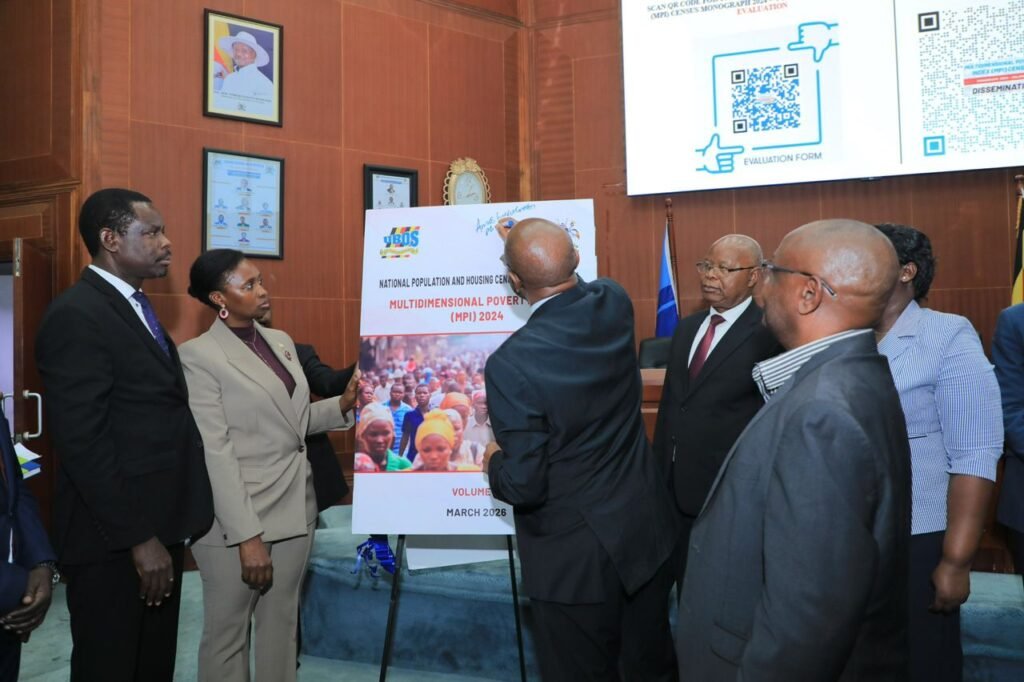
Minister of state for Finance, Planning and Economic Development Amos Lugoloobi signing on the dummy report
By Ambrose Gahene
The Uganda Bureau of Statistics (UBOS) Multidimensional Poverty Index (MDPI) report shows that newly created districts are worse hit by poverty levels. The report released on Thursday points out that newly created districts and elite capture of resources are route causes of poverty levels and derails the Parish Development Model (PDM) Government initiatives.
Dr. Chris Mukiza, UBOS executive director, said poverty levels in newly created districts are attributed to the fact that resources meant for poor communities are diverted by local elites, and that this has negatively affected the PDM agenda to eradicate poverty among households.
He said MDPI has further unveiled lack of sufficient healthcare, education, clean water and other social amenities in the said districts. The report names worst poverty hit districts to include those from Karamoja sub-region, with Kaboong district worst hit at the rate of 56 percent.
Others include; West Nile at 39 percent, Sebei at 33 percent, Acholi at 33.2 percent, Rwenzori at 32.2 percent, Tooro at 31 percent, Bukedi at 30.9 percent, and Bunyoro at 30.1 percent.
The report further points out that 27 percent of Ugandans are classified as multidimensionally poor and are deprived of social amenities such as education, health, living standards, and other essential services.
Buganda region is recorded with the lowest levels of multidimensional poverty at 18 percent, followed by Teso at 24 percent, Lango at 25 percent, and Ankole at 25.8 percent.
State Minister for Finance (Planning), Amos Lugoloobi, hailed UBOS for the statistics, saying it’s upon these data that the Government will address key challenges in the Ugandan communities.
“We now have the baseline data which we never used to have. This is important in realizing vision 2040”, he said.
He added that; Government has invested heavily in poverty reduction from 56 percent in 1992 to 16 percent in 2024. He said PDM came about as a result of UBOS data and called upon households to venture into the money economy using PDM funds.