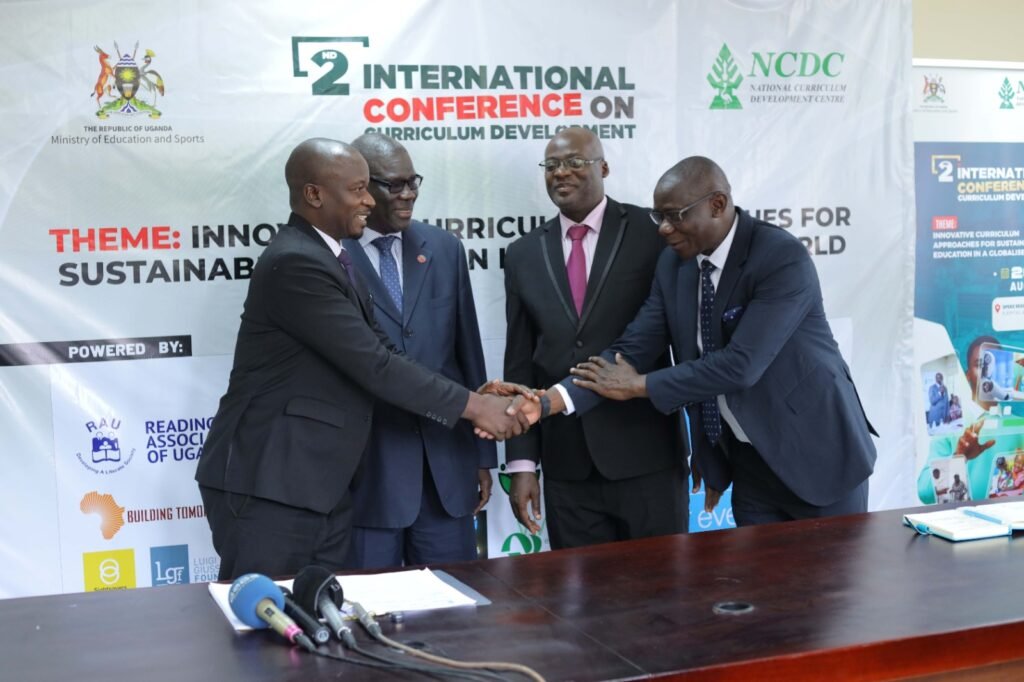
By Ambrose Gahene
The National Curriculum Development Centre (NCDC) has unveiled the 2nd International Conference on Curriculum Development, scheduled for 20th and 21st August 2026 at Speke Resort and Convention Centre, Munyonyo, Kampala, Uganda.
The revelation was made at a press conference, held on Sunday at the NCDC offices at Kyambogo in Kampala.
The Conference will be held under the theme: “Innovative Curriculum Approaches for Sustainable Education in a Globalized World.”
Prof. George Lagaah Openjuru, Chairperson of the NCDC Council, said the conference builds on the success of the inaugural 2023 edition and is positioned as a critical platform for shaping how education responds to Uganda’s social and economic transformation agenda.
“The Conference builds on the inaugural International Conference on Trends in Curriculum Development and Implementation held by NCDC in April 2023.”
“The first Conference provided a platform for education stakeholders to share experiences and best practices in curriculum development and implementation, and attracted participants from more than 12 countries”, he said.
Prof.Openjuru said the 2nd International Conference provides another opportunity for curriculum experts, researchers, policymakers, teachers and other education stakeholders to reflect on emerging trends, innovations and challenges in curriculum development and implementation.
“The Conference comes at a time when education systems are responding to rapid technological advancement, Artificial Intelligence, climate change, changing labour markets and evolving expectations of learners and societies”, he added.
Dr. Patrice Ssembirige, Acting Director of NCDC, said the Centre’s mandate has expanded significantly since the NCDC Amendment Act of 2021, which now requires NCDC to vet and approve all external and international curricula before adoption in Ugandan schools. The institution, established in 1973, is responsible for developing and reviewing curricula for Pre-Primary, Primary, and Secondary levels, and for supporting implementation through teacher training, research, and quality assurance.
Dr. Ssembirige outlined recent reforms anchoring NCDC’s work to Objective Two of the Fourth National Development Plan (NDP IV): “Enhance Human Capital Development along the entire life cycle.”
“At Lower Secondary, NCDC rolled out a revised competency-based curriculum in 2020, shifting emphasis from rote memorization to practical skills.
“The success of the Competency-Based Curriculum will not be measured simply by how much content a learner can remember, but by what that learner can do with what they have learned,” Dr. Ssembirige said.
“We want a generation of Ugandans who can think critically, solve problems, communicate effectively, work with others, innovate, adapt to change and use their knowledge to improve their communities. CBC is therefore not simply a change in the curriculum; it is a change in the kind of citizen we are preparing for Uganda’s future”, he added.
He further added that NCDC has commenced a comprehensive review of the Primary School Curriculum with a new framework developed, while the Advanced Level curriculum is under review to ensure smooth transition from Lower Secondary. In Special Needs Education, adapted learning materials and support guidelines have also been produced to enhance access and participation.
The Conference, according to organizers aims to provide a platform for sharing research, experiences, innovations and best practices in curriculum development and implementation, while strengthening collaboration among education stakeholders nationally, regionally and internationally.
“It will facilitate dialogue on how curriculum can become more relevant, inclusive, innovative and responsive to the needs of learners and sustainable national development.”, Dr. Openjuru further stated.
He concluded by saying’ the conference will focus on eleven thematic areas, namely: CT and Artificial Intelligence Integration in Education; Sustainability and Global Citizenship in Education; Interdisciplinary Approaches to Curriculum Development and Indigenous Knowledge Systems and Localized Curriculum among others.